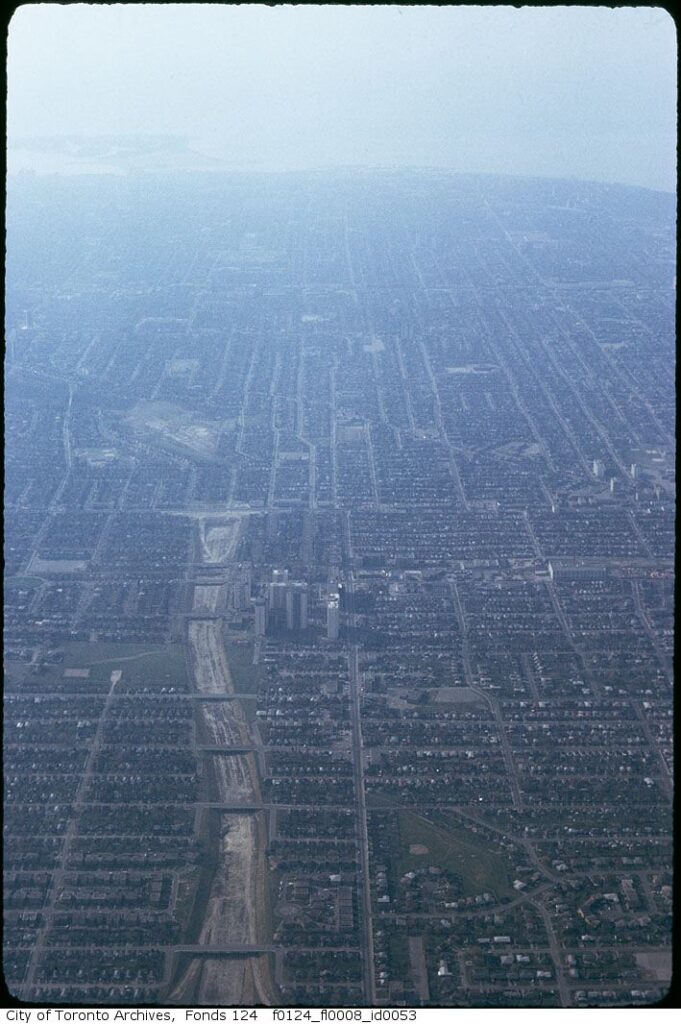
Spadina Expressway, south of Lawrence Avenue West, from air | April 21, 1974
The photograph is taken from the air somewhere above Lawrence Ave, looking south, with Lake Ontario barely visible through the haze.
Extending through the greenery and the tight blocks of houses is a great grey trench cutting its way to the lake, only to stop abruptly.
Bridges cross the trench at regular intervals as if the neighbourhoods are trying to heal from this ugly incision.
Years later, the trench would become known as Allen Road. The carved basin captured in the photograph is now covered in grass and outlined by two roads—one going north, one south—with a TTC line running through its centre. The area around it has since mostly adapted to its presence, although it reliably gums up traffic every rush hour. From where it meets Eglington Ave, it runs north past Lawrence Ave, past Yorkdale shopping centre, and past the 401 to eventually continue as Dufferin Street around Sheppard Ave.
The photograph on its own is not particularly impressive; it’s just a half-finished highway running through an area that is not especially interesting from the air. But the photograph becomes evocative the moment you start to wonder why the road stops where it does.
What is now Allen Road was just the beginning of a much more ambitious project: the Spadina Expressway. Several plans for the expressway were proposed and adopted, debated and discarded. It was conceived in the 1950s as part of a series of projects that would open Toronto’s downtown core to greater automobile traffic from the suburbs; other pieces of this plan included the Don Valley Parkway and the Gardiner Expressway.
Its starting point in North York was generally agreed upon, but the extent of its incursion was never settled. One plan in 1970 had it following Cedarvale Creek, then tunneling under St Clair Ave only to emerge again on Spadina Road. From there it would open into a large thoroughfare with the TTC line running down the middle of it. This plan would empty cars into the city around Harbord Street, but other plans called for its continuation south through Chinatown.
City officials in North York were thrilled by the prospect of greater access to downtown, and major infrastructure projects like the Yorkdale shopping centre were initiated in tandem. Excavation began, and the enormous below-grade trench started inching its way into the city’s core. Over three hundred homes in North York were expropriated and destroyed to make way for the Expressway, and low-income communities like the Lawrence Heights housing project were cleaved in two.
Soon enough, people downtown started sounding the alarm. The Expressway threatened to cut through the middle of the Annex and the neighbourhood’s residents—generally more affluent, educated, and politically connected than their Norh York counterparts—soon launched a campaign to “Stop Spadina”. The movement featured prominent voices like Marshall McLuhan the celebrity communications professor at UofT, who produced a documentary outlining the negative impact the Expressway would have on Toronto’s urban life. Jane Jacobs, the well-known writer, journalist, and urbanist had moved to the Annex not long after leading a successful campaign to shut down the Lower Manhattan Expressway that would have devastated Greenwich Village. She brought her expertise and her profile to the campaign and co-wrote the documentary with McLuhan.
Residents of the Annex and other downtown neighbourhoods joined the fight and pressured their politicians with rallies, letter-writing campaigns, and direct actions, like planting trees in the unfinished trench. City council remained stalwart defenders of the Expressway, and although the campaign built steam and drew in support, construction still crawled southward.
Finally, in 1971, Ontario premier Bill Davis caved to public pressure and announced that the province would not continue supporting the Spadina Expressway. Without provincial buy-in, the plan crumbled, and the expressway hawks went on to focus their energies on less contentious building projects.
The organizing efforts of downtown residents, especially in the Annex, built the connections and the confidence to fuel a wave of civic activism that continued strong through the 1970’s. Its legacy as one of Toronto’s most successful grassroots campaigns continues to inform and inspire advocacy groups like TTCriders.
The era of expressways has had a devastating impact on the city of Toronto, which has never been able to wean itself off cars. In Lawrence Heights, plans are being proposed to build a park over Allen Road, but the community has never fully recovered from being broken in two.
Still, it is difficult to imagine what downtown Toronto would look and feel like if the Spadina Expressway had been allowed to continue. Chinatown would have suffered the same fate as Lawrence Heights, and the proposed interchanges at Bathurst, Dovercourt, and Harbord would have totally reconfigured the communities around them.
Looking at this photograph from the archives, it is easy to picture the barren trench of the Spadina Expressway continuing into the haze of downtown. Instead, it stands stopped in its tracks as a testament to the power of community organizing and a warning about what could have been.